
Best Kitchen Cooling Systems for Home
Table of Contents
- Types of Kitchen Cooling Systems
- Portable Air Conditioner for Kitchen: Features and Benefits
- How to Cool a Hot Kitchen: Practical Strategies
- Energy Efficiency and Power Consumption
- BTU Output and Cooling Capacity Requirements
- Installation Requirements and Setup
- Maintenance, Cleaning, and Filter Care
- Smart Home Integration and Controls
- Frequently Asked Questions
Last Updated: August 31, 2026
Types of Kitchen Cooling Systems
Your choice of kitchen cooling depends on layout, budget, cooling power needed, and whether you're renovating or working with existing space. The main categories break down into four distinct systems, each with different installation requirements, energy consumption, and long-term costs.
Portable Air Conditioners
Portable air conditioners are the fastest way to add cooling without permanent installation. They sit on the floor, roll on wheels, and connect to a window using an exhaust hose. No drilling, no permanent modifications required.
The appeal is obvious for renters or anyone hesitant about major changes. You can move the unit between rooms and haven't committed financially or structurally if you decide it's not right.
Portable units are louder than permanent systems, consume more energy per BTU, and require regular maintenance on the exhaust hose and filters. For kitchens with limited window access, routing the hose becomes a puzzle.
The Crestpoint Home 14000 BTU Smart Portable AC with APP Voice Control ($639.99) handles rooms up to 750 square feet with a 7.95 CEER rating. It operates at 47 dB and includes a 24-hour timer, app control, and voice compatibility.

Ductless Mini-Split Systems
Ductless mini-split systems represent the middle ground between portable units and full central air. An indoor wall-mounted unit connects via refrigerant lines to an outdoor condenser. Installation requires running lines through a small hole in the wall, but no ductwork means no major renovation.
Mini-splits deliver superior cooling efficiency, run quietly, and free up counter and floor space. The downside is installation cost, you'll need a licensed HVAC technician, and upfront expense is significantly higher than a portable unit. Professional maintenance is also required.
Window Air Conditioners
Window units slide into an existing window frame and seal around the edges. Installation takes 30 minutes with minimal tools. They're affordable and effective for single rooms.
In kitchens, they work well if you have a suitable window near the cooking area. Problems emerge quickly: they block natural light, obstruct views, and grease from cooking accumulates on exterior coils, requiring frequent maintenance.
Evaporative Coolers
Evaporative coolers work by drawing air through water-saturated pads, cooling through evaporation. They use significantly less energy than compressor-based systems and produce no refrigerant emissions.
The critical limitation: they only work effectively in dry climates. In humid regions, evaporative cooling loses its advantage. Kitchens also generate steam and humidity during cooking, further reducing effectiveness. For most kitchens east of the Rocky Mountains, evaporative coolers aren't practical.
Portable Air Conditioner for Kitchen: Features and Benefits
A portable air conditioner designed for kitchen use solves the immediate problem without requiring permanent changes. The best models combine cooling, dehumidification, and fan-only operation for flexibility beyond just temperature control.

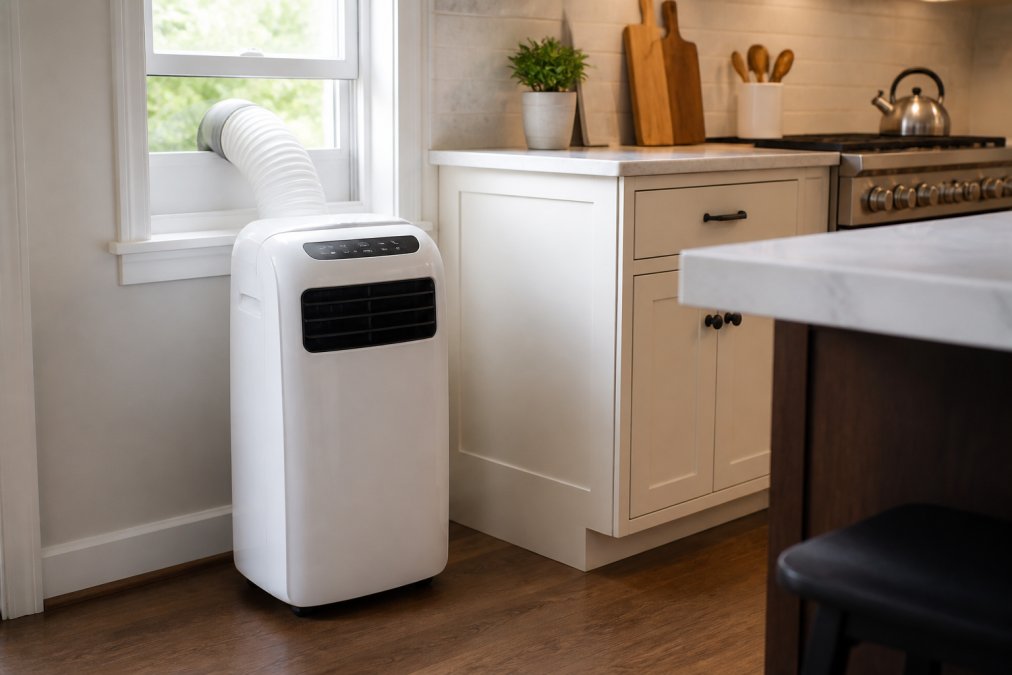
Cooling capacity matters more in kitchens because ovens, stovetops, and cooking equipment generate constant heat spikes. A unit rated for 14,000 BTU handles kitchens up to 750 square feet effectively (energy.gov). The CEER (Cooling Efficiency Ratio) rating indicates how efficiently the system converts electricity into cooling, a 7.95 CEER rating represents solid efficiency for a portable unit (energystar.gov).
Dehumidification is often overlooked until needed. Kitchens produce steam and moisture constantly. Units that pull 65 pints of moisture per day handle kitchen humidity without struggling.
Noise level matters when cooking or entertaining. A 47 dB rating, comparable to normal conversation, lets you operate the system while talking without shouting. Sleep mode reduces noise further for overnight operation.
Smart controls add convenience. App-based operation lets you turn the system on before entering the kitchen, and voice control integrates with existing smart home setups. A 24-hour timer schedules operation around your cooking schedule.
How to Cool a Hot Kitchen: Practical Strategies
Cooling a hot kitchen requires more than just buying equipment. The best approach combines equipment selection with operational strategies that address how kitchens generate and distribute heat.
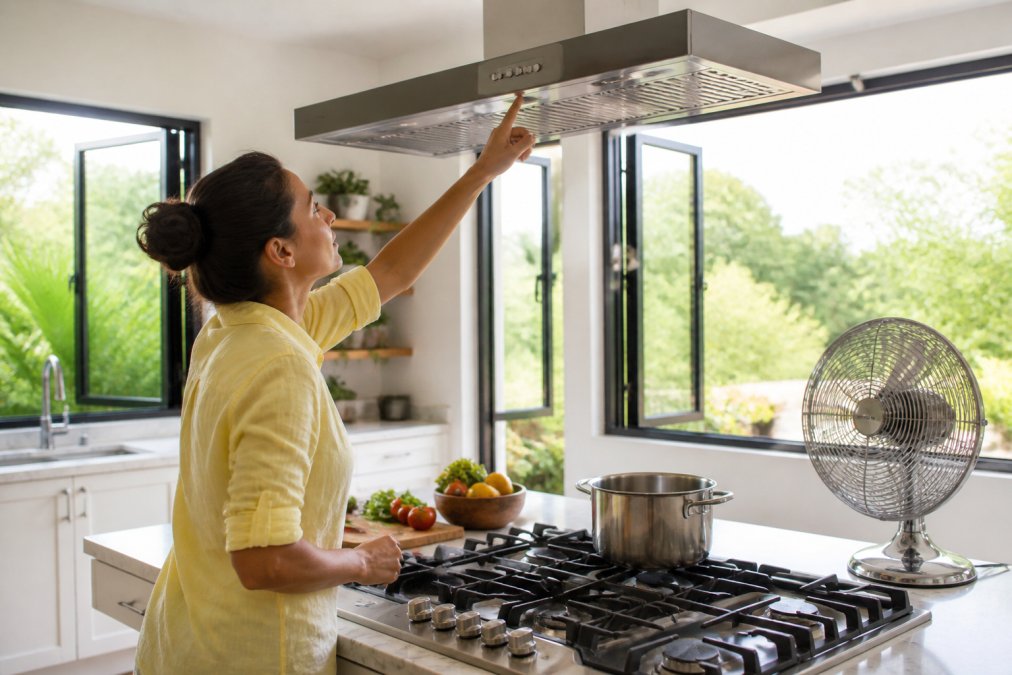
Managing Heat Sources
Ovens and stovetops are the primary heat generators. Use exhaust fans aggressively during cooking at full speed to pull hot air directly out before it spreads throughout the space.
Induction cooktops generate less ambient heat than gas or electric resistance elements. If renovating, induction reduces the cooling load your system must handle.
Timing matters. Cook during cooler hours when possible. Early morning or evening cooking generates heat when outdoor temperatures are lower, making it easier for your cooling system to manage.
Ventilation and Airflow Circulation
Cross-ventilation, opening windows on opposite sides of the kitchen, creates natural airflow that moves hot air out without relying entirely on mechanical cooling. This works best during early morning or evening when outdoor temperatures drop below indoor levels.
Position your portable AC unit where it can draw return air from the hottest part of the kitchen and push cooled air toward the main living space. Avoid blocking the intake or exhaust with furniture or appliances.
Ceiling fans complement AC units by distributing cooled air throughout the space. Run fans in reverse during winter to push warm air down from the ceiling.
Placement and Ergonomics
Position your cooling system where it doesn't obstruct traffic flow during meal preparation. Place it along a wall or in an underutilized corner. The exhaust hose should have a direct, unobstructed path to the window.
Locating the unit away from dining or seating areas reduces the subjective noise impact even if the decibel rating stays the same.
Energy Efficiency and Power Consumption
Energy efficiency directly impacts your utility bills and environmental footprint. The CEER rating measures how many BTUs of cooling you get per watt of electricity consumed. A 7.95 CEER rating means the system delivers 7.95 BTUs of cooling for every watt used. Over a summer season, the difference between a 6.0 CEER unit and an 8.0 CEER unit translates to measurable savings.
R32 refrigerant, used in modern systems, offers better thermodynamic efficiency than older refrigerants and carries a lower global warming potential (the EPA). Running costs depend on usage patterns. A 24-hour timer helps optimize usage by scheduling cooling for peak heat hours rather than continuous operation.
BTU Output and Cooling Capacity Requirements
BTU (British Thermal Units) measures the amount of heat a system removes per hour. A common rule suggests 20 BTU per square foot for average conditions. A 750-square-foot kitchen would need roughly 15,000 BTU capacity. However, kitchens generate more heat than typical rooms, so you might need 25-30 BTU per square foot to handle cooking heat effectively.
The difference between ASHRAE BTU rating (laboratory conditions) and SACC BTU rating (real-world conditions) matters. The 14000 BTU ASHRAE rating translates to 10000 BTU SACC, which reflects actual performance. Use the SACC number when calculating whether a unit meets your needs.
| Cooling Capacity | Coverage Area | Best For | Considerations |
|---|---|---|---|
| 10,000 BTU SACC | 500-600 sq.ft. | Smaller kitchens, apartments | May struggle with heavy cooking |
| 14,000 BTU SACC | 700-800 sq.ft. | Standard kitchens | Handles cooking heat effectively |
| 18,000 BTU SACC | 900-1000 sq.ft. | Large kitchens, open layouts | Higher energy consumption |
Installation Requirements and Setup
Portable air conditioners require minimal installation. Most units arrive ready to operate with basic assembly needed. The exhaust hose connects to the window kit, which adapts to different window types. Setup typically takes 15-30 minutes: place the unit, attach the hose to the window kit, insert the kit into your window, and plug in the power cord.
No permanent modifications are required. Renters can install and remove portable units without landlord concerns.
Mini-split systems require professional installation by a licensed HVAC technician, typically costing $1,500-$3,000. Window units need minimal installation but permanent window obstruction and grease accumulation make them less practical for kitchens.
Maintenance, Cleaning, and Filter Care
Portable air conditioners need regular maintenance to operate efficiently and maintain air quality.
Grease Filtration and Air Quality
Kitchen air contains grease particles from cooking. Removable and washable filters prevent grease from reaching internal components and are easier to clean than disposable filters.
Check filters weekly during heavy cooking periods. A clogged filter forces the system to work harder, increasing energy consumption and reducing cooling capacity. Wash filters in warm water with mild soap and let them dry completely before reinstalling.
Charcoal filters improve air quality by absorbing cooking odors. Some portable units include charcoal filtration as standard.
Noise Level and Decibel Ratings
A 47 dB rating (comparable to normal conversation) is acceptable for daytime operation. Sleep mode reduces noise to roughly 40 dB for overnight cooling.
Noise increases as filters clog or if the unit isn't positioned on a stable, level surface. Place the unit on a hard, level surface, not carpet. Running at lower fan speeds reduces noise but also reduces cooling capacity.
Smart Home Integration and Controls
Modern portable air conditioners integrate with smart home systems, letting you control cooling through your phone, voice commands, or automation routines.
App-based control means you can turn the system on before arriving home or adjust temperature from the living room. Voice control through Alexa or Google Home adds convenience when your hands are occupied with cooking.
Scheduling features optimize energy use by running during specific hours. A physical remote provides immediate control without phone dependency.
Choosing the right kitchen cooling system depends on your specific situation. For renters or those avoiding permanent installation, a portable air conditioner like the Crestpoint Home 14000 BTU Smart Portable AC delivers efficient cooling without commitment. For homeowners planning long-term solutions, ductless mini-split systems offer superior efficiency and aesthetics, though at higher upfront cost.
At Crestpoint Home, we understand that kitchen comfort directly impacts how you cook and entertain. Our curated selection of cooling systems combines high-performance equipment with the support you need to make confident choices. Whether you're upgrading a small apartment kitchen or renovating a full culinary space, our team is available via phone, email, or live chat to help you find the solution that fits your needs. Explore our collection of premium kitchen cooling systems and transform your space into a comfortable, functional retreat. SHOP THE COLLECTION
Frequently Asked Questions
Which type of AC is best for a kitchen?
The best kitchen cooling system depends on your space and needs. Portable air conditioners like the 14000 BTU Smart Portable AC ($639.99) work well for smaller kitchens up to 750 square feet, offering flexibility and easy installation. Ductless mini-split systems provide more permanent cooling without window obstruction. Window units suit kitchens with suitable window space. For kitchens with heavy cooking heat, prioritize units with high BTU output, good dehumidification capacity, and efficient air circulation to handle thermal loads from ovens and stoves.
Are portable air conditioners effective for high-heat kitchen environments?
Yes, portable air conditioners are effective in kitchens when sized correctly. A unit with 14,000 BTU cooling capacity and a 7.95 CEER rating handles rooms up to 750 square feet. They excel at managing dehumidification (up to 65 pints per day), which is critical in kitchens where cooking creates moisture. Position the unit to maximize airflow circulation away from heat sources, and ensure the exhaust hose is properly routed outside. For kitchens with multiple heat sources, combine cooling with ventilation management and heat source control.
How do you keep a kitchen cool without central air?
Keep a hot kitchen cool using multiple strategies: install a portable or window air conditioner for active cooling, use exhaust fans to remove cooking heat and steam, open windows for cross-ventilation during cooler hours, and install reflective window treatments to reduce solar gain. Manage heat sources by using lids on pots, cooking during off-peak hours, and using smaller appliances when possible. A combination approach, active cooling plus ventilation plus heat management, is most effective. The 14000 BTU Smart Portable AC with app control lets you schedule cooling in advance.
What's the difference between BTU output and CEER rating?
BTU (British Thermal Units) measures cooling capacity, how much heat an air conditioner can remove. The 14000 BTU Smart Portable AC removes 14,000 BTU per hour. CEER (Cooling Efficiency Ratio) measures energy efficiency: how much cooling you get per watt of electricity used. A 7.95 CEER rating indicates good efficiency. Higher CEER means lower energy bills. For kitchens, choose a unit with sufficient BTU for your square footage and a CEER rating above 7.0 to balance cooling power with energy consumption.
Do I need professional installation for a portable air conditioner in my kitchen?
Portable air conditioners require minimal professional installation. The 14000 BTU Smart Portable AC includes a window slider kit and exhaust hose, you slide the window adapter into your window frame and attach the hose. Assembly is required but straightforward. The unit has wheels for easy movement and recessed handles. No electrical work or structural modifications are needed. However, if you're installing a ductless mini-split or window unit, professional installation is recommended to ensure proper refrigerant handling and sealing.
This article was written using GrandRanker