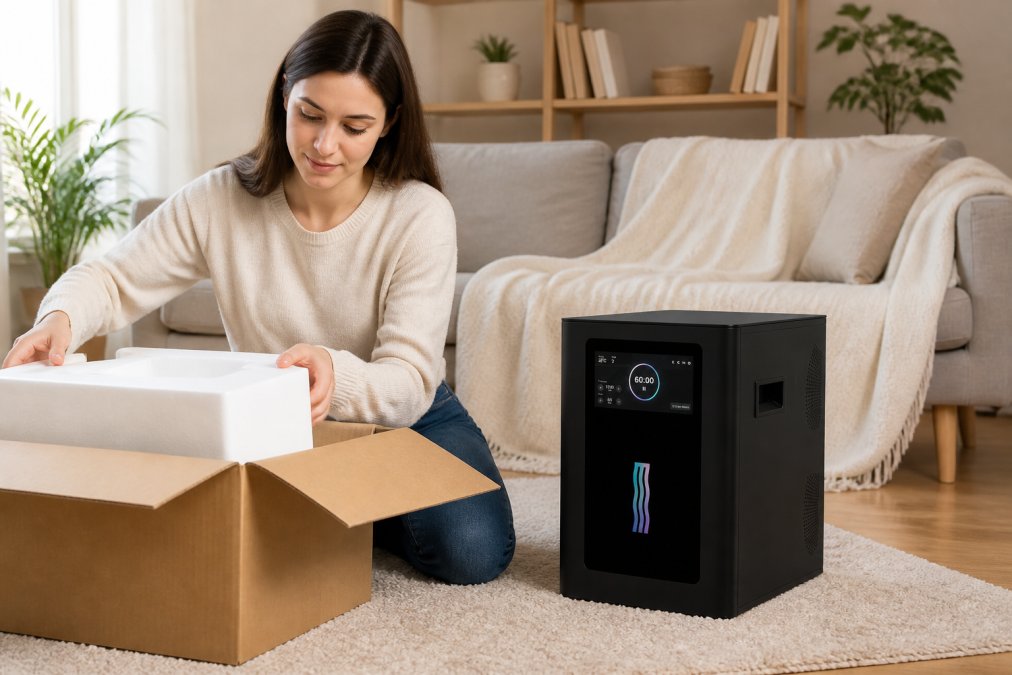


How to Fit Cooling Systems in Small Kitchens
Table of Contents
- Assess Your Kitchen's Thermal Load and Space Constraints
- Best Compact Kitchen Ventilation Systems for Small Spaces
- Strategic Placement of Exhaust Fans and HVAC Returns
- Portable Air Conditioner for Kitchen Use and Spot Cooling
- How to Improve Kitchen Airflow Without Windows
- Kitchen Layout Optimization and Zoning Strategies
- Installation Tips and Common Mistakes to Avoid
- Conclusion
Last Updated: August 26, 2026
Assess Your Kitchen's Thermal Load and Space Constraints
Understanding your kitchen's thermal load, the total heat generated by appliances, cooking activity, and environmental factors, determines which cooling solution will work without oversizing or undersizing your system.
Start by measuring your kitchen's square footage. A 150-square-foot kitchen has fundamentally different cooling needs than a 250-square-foot one. Oversized systems waste energy and create temperature swings; undersized ones can't keep up during peak cooking times.
Calculate BTU requirements for your square footage
The rule of thumb is approximately 20 BTU per square foot for cooling, but kitchens need more because they generate significant internal heat (energy.gov). Add 1,000-2,000 BTU for each major heat-producing appliance: a gas range, wall oven, or commercial-grade cooktop.
For a 200-square-foot kitchen with a gas range and wall oven, calculate: (200 × 20) + 2,000 + 1,500 = 7,500 BTU minimum. However, you need 15-20% additional capacity to handle peak loads. That same kitchen actually needs a 9,000-10,000 BTU system to perform reliably.
Identify heat sources and appliance placement
Map where heat concentrates in your kitchen. Stand during cooking and notice where you feel warmth, near the stove, above the refrigerator, or where the oven vents. These hot spots reveal where ventilation efficiency is already failing.
Appliance placement directly impacts thermal load. A refrigerator placed against an exterior wall in direct sunlight works harder and radiates more heat into your kitchen. A gas range positioned in a corner creates heat trapping; the same range on an island allows heat to dissipate naturally.

Check your current ventilation. If you have a range hood, does it vent outside or recirculate? Recirculating hoods filter grease but return hot air to your kitchen, adding to your cooling burden. An exterior-venting hood removes heat and humidity at the source.
Best Compact Kitchen Ventilation Systems for Small Spaces
The best compact ventilation systems balance performance with spatial efficiency. In a small kitchen, your ventilation choice determines whether cooling works or fails.
Under-cabinet and downdraft ventilation hoods
Under-cabinet ventilation hoods mount flush to cabinetry and don't consume overhead space. They're available in widths from 24 to 42 inches. A 30-inch hood works for most residential ranges; go to 36 inches if you have a wider cooktop or island installation.
The critical specification is CFM (cubic feet per minute), the volume of air the hood moves. For a small kitchen with proper ducting, 300-400 CFM handles normal cooking. If you cook frequently or use high-heat methods like searing or wok cooking, aim for 500+ CFM.
Downdraft systems pull air down through the cooktop and duct it away horizontally or downward. They're ideal when you can't run ductwork upward, in kitchens with cathedral ceilings, open floor plans, or island cooktops. Downdraft systems typically move 300-350 CFM, adequate for most small kitchens if ductwork is properly sized and vented directly outside.
Ductless mini-split systems and energy efficiency ratings
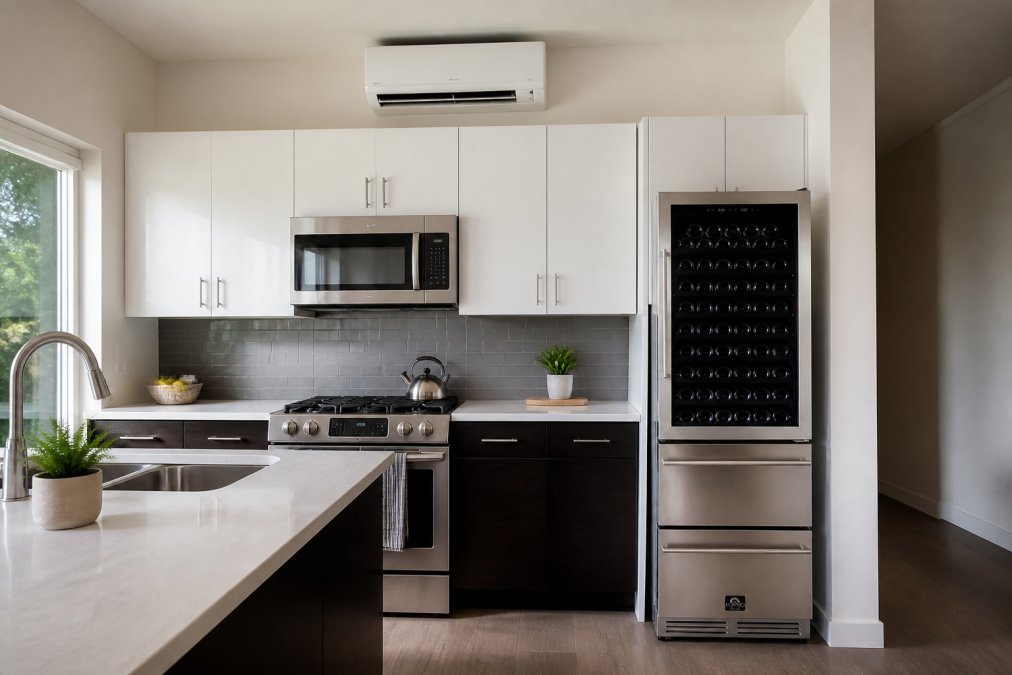
Ductless mini-split systems connect a wall-mounted indoor unit to an outdoor compressor via refrigerant lines. They cool and dehumidify without requiring ductwork, valuable for kitchens where running traditional HVAC ducts is impractical.
Energy efficiency ratings for mini-splits are expressed as SEER2 (Seasonal Energy Efficiency Ratio). A SEER2 rating of 15 or higher indicates excellent efficiency; 18+ is premium (energystar.gov). For a small kitchen running cooling frequently, the difference between SEER2 15 and SEER2 20 can be $200-400 annually in electricity costs.
Mini-splits excel at zoning and operate at 22-28 decibels, quieter than most range hoods. The trade-off is upfront cost: $3,000-5,000 installed, compared to $800-1,500 for a traditional range hood and ducting. They make sense if you have open floor plans where traditional ducting is impossible, need whisper-quiet operation, or require precise temperature control independent of your home's main HVAC system.
Strategic Placement of Exhaust Fans and HVAC Returns
Where you place exhaust fans and HVAC returns determines whether your cooling system actually removes heat or just pushes it around.
Ceiling-height returns and heat capture techniques
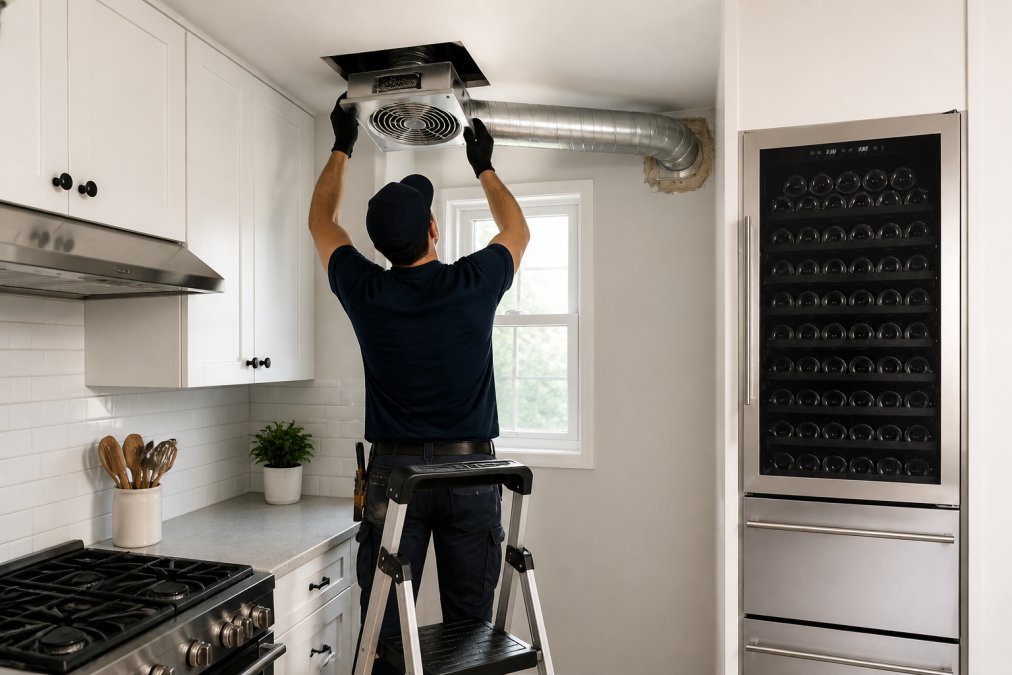
HVAC returns should be positioned high on walls or in ceiling soffits, not near the floor. Heat rises, so ceiling-height returns capture hot air before it settles throughout your kitchen. Position returns within 12-18 inches of the ceiling line.
The distance between your exhaust outlet and HVAC return matters. If they're too close, within 3-4 feet, the system recirculates air without properly conditioning it. Ideally, separate them by at least 8-10 feet, or position them on opposite walls. A return positioned directly above your cooktop captures rising heat before it reaches the rest of your kitchen, reducing the total cooling load on your system.

Air intake positioning and cross-ventilation
Air intake should pull fresh, cooler air into the kitchen rather than recirculating hot air. Position intakes on opposite walls or at different heights from exhaust outlets to avoid short-circuiting.
Cross-ventilation uses opposing windows or doors to create airflow. Open a window on one side of your kitchen and a door or window on the opposite side. This creates a pressure differential that moves air through the space. In small kitchens, cross-ventilation can reduce your cooling system's workload by 15-20% during mild weather (peer-reviewed research). Use smooth 6-inch or 7-inch ducts rather than cramped 5-inch runs, and minimize elbows and bends.
Portable Air Conditioner for Kitchen Use and Spot Cooling
Portable air conditioners are pragmatic for renters, temporary solutions, and small kitchens where permanent installation isn't feasible. They're also legitimate spot-cooling tools when you don't need to cool your entire kitchen uniformly.
Selecting the right cooling capacity and noise levels
Portable units are rated by BTU. A 6,000 BTU unit cools 150-200 square feet. An 8,000 BTU unit handles 200-250 square feet. For spot cooling a prep area, 5,000-6,000 BTU is sufficient. For cooling an entire small kitchen, you need 8,000-10,000 BTU.
Noise is the critical specification most buyers overlook. Portable air conditioners typically run 50-65 decibels, comparable to a vacuum cleaner. Energy efficiency ratings for portable units are measured as EER (Energy Efficiency Ratio). Look for EER of 11 or higher.
Portable units require window installation kits for the exhaust hose. Without proper venting, the unit pulls cooled air from your kitchen and exhausts it outside, creating negative pressure that pulls warm air in through gaps and cracks. Always vent to the outside.
Placement strategies for prep areas and compact zones
Position your portable unit to cool the zone where you spend the most time or generate the most heat. If you're primarily a prep cook working at the counter, place the unit 6-8 feet away, angled toward your work surface. Avoid placing portable units directly in front of windows where sunlight heats them. Ensure at least 12 inches of clearance around the unit's air intake.
How to Improve Kitchen Airflow Without Windows
Kitchens without windows face unique challenges: no natural light, no cross-ventilation, and trapped heat with nowhere to escape.
Air circulation techniques and passive cooling design
Passive cooling uses design principles rather than energy to manage temperature. Light-colored walls and ceilings reflect heat instead of absorbing it. A white or light gray kitchen stays noticeably cooler than one with dark cabinetry, reducing perceived temperature by 3-5 degrees in a small space.
Insulated ductwork minimizes heat transfer. If your exhaust duct runs through an unconditioned attic, the duct itself becomes a heat source in summer. Wrapping ducts with 1-2 inches of foam insulation reduces this effect. Ceiling fans improve air circulation without adding cooling. Position fans to push air downward during cooling season.
Smart home integration for temperature regulation
Smart thermostats learn your cooking patterns and adjust cooling preemptively. If you cook at 6 PM every weekday, the system can begin cooling at 5:30 PM, so your kitchen reaches target temperature when you start.
Smart exhaust fans with humidity sensors activate automatically when humidity exceeds a threshold. Smart mini-split systems allow zone control from your phone, letting you preheat or cool your kitchen before you arrive home.
Kitchen Layout Optimization and Zoning Strategies
How you arrange your kitchen determines whether your cooling system works efficiently or fights an uphill battle.
Heat source mitigation through appliance arrangement
Position heat-generating appliances away from where you spend the most time. If your refrigerator, wall oven, and cooktop are clustered in one corner, that corner becomes a thermal hot zone.
Separate your cooktop from your refrigerator by at least 3-4 feet. When these are adjacent, the refrigerator works harder to maintain cold temperature, consuming more energy and radiating waste heat into your kitchen. Island cooktops are superior to wall-mounted ones in small kitchens because heat dissipates in all directions instead of concentrating against a wall. Ensure at least 18 inches of open space on all sides of your cooktop to allow heat to escape naturally.
Commercial vs. residential cooling approaches
Commercial kitchens use makeup air systems, dedicated intake fans that pull outside air into the kitchen to replace exhaust. Adding a makeup air damper to your range hood solves this for residential kitchens. When the hood exhaust runs, the damper opens, pulling outside air directly into your kitchen. The cost is $200-400 for the damper and installation.
Commercial kitchens also use radiant cooling, cooling the surfaces people work near rather than cooling the entire air volume. For residential kitchens, this means positioning your portable air conditioner or mini-split unit to cool the prep area directly, not the whole kitchen.
Installation Tips and Common Mistakes to Avoid
Installation quality determines whether your cooling system performs as designed or underperforms.
Static pressure management and ventilation efficiency
Static pressure is the resistance to airflow in your ductwork. Undersized ducts, too many elbows, or clogged filters create high static pressure. Your fan works harder, moves less air, and consumes more energy.
Use appropriately sized ductwork. A range hood rated at 400 CFM needs 6-inch ducts minimum. Cramming it into 5-inch ducts increases static pressure by 30-40%, reducing actual airflow to 280-300 CFM. For small kitchens, this difference is the margin between adequate cooling and inadequate cooling. Minimize ductwork runs and use smooth ducts with gentle curves rather than sharp 90-degree elbows.
Humidity control and air quality considerations
Small kitchens with inadequate ventilation develop humidity problems. Moisture from cooking condenses on windows, mirrors, and cabinetry, causing mold, wood swelling, and paint peeling. After cooking, run the hood for 15-20 minutes with the kitchen door closed to ensure moisture is exhausted outside rather than spreading to adjacent rooms.
If you use a gas cooktop, understand that it produces nitrogen dioxide and carbon monoxide during combustion. These are exhausted by the range hood if properly vented outside. A recirculating hood leaves these combustion byproducts inside. For gas cooktops, exterior venting is necessary for air quality.
| Cooling Method | Best For | Noise Level | Upfront Cost | Energy Efficiency |
|---|---|---|---|---|
| Range hood with exterior duct | Heat removal at source | 50-65 dB | $800-1,500 | High (removes heat) |
| Ductless mini-split | Zone cooling, quiet operation | 22-28 dB | $3,000-5,000 | Very high (SEER2 15+) |
| Portable air conditioner | Renters, spot cooling | 50-65 dB | $400-800 | Moderate (EER 11+) |
| Ceiling fan | Air circulation | 35-45 dB | $100-300 | Very high (minimal energy) |
Fitting cooling systems into small kitchens requires understanding your thermal load, choosing the right combination of ventilation and cooling equipment, and installing it strategically. The most common mistake is oversizing a single system instead of layering multiple approaches: a properly vented range hood handling heat at the source, a mini-split or portable unit providing spot cooling, and smart placement of appliances to prevent heat clustering.
At Crestpoint Home, we understand that small-kitchen cooling isn't one-size-fits-all. Our curated selection of high-performance cooling solutions and kitchen essentials helps homeowners make confident choices about which systems work for their specific space. Whether you're considering a ductless mini-split system, upgrading your ventilation, or adding spot cooling capacity, our team is available via phone, email, or live chat to provide expert guidance tailored to your kitchen's unique constraints. SHOP THE COLLECTION to explore cooling solutions designed for modern kitchens of all sizes.
Frequently Asked Questions
Q: What size cooling system do I need for my small kitchen?
A: Calculate BTU requirements by multiplying your kitchen's square footage by 25. A 100-square-foot kitchen needs roughly 2,500 BTU capacity. However, add 10-15% if your kitchen has multiple heat sources like ovens or refrigerators. Portable units typically range from 5,000 to 14,000 BTU, while mini-split systems offer more precise capacity control. Crestpoint Home provides detailed product specifications to help match cooling solutions to your exact space and thermal load.
Q: Can I install a ductless mini-split system in a small kitchen?
A: Yes, ductless mini-split systems work exceptionally well in small kitchens because they require minimal space and offer energy-efficient cooling without extensive ductwork. They feature low noise levels, adjustable temperature zones, and smart home integration capabilities. The indoor unit mounts on a wall or ceiling, taking up far less space than traditional HVAC returns. This makes them ideal for kitchens where space and thermal comfort are priorities, though professional installation is recommended for optimal performance.
Q: What are the most common mistakes when planning kitchen ventilation?
A: Common mistakes include undersizing the ventilation system (failing to account for thermal load from appliances), improper exhaust fan placement that creates dead zones, ignoring static pressure issues that reduce airflow dynamics, and neglecting humidity control. Many homeowners also place returns too low, missing heat that rises near the ceiling. Additionally, choosing systems without considering noise levels or energy efficiency ratings leads to dissatisfaction. Proper assessment of your kitchen layout, appliance arrangement, and air circulation patterns prevents these costly errors.
Q: Are portable air conditioners effective for small kitchen spaces?
A: Portable air conditioners are effective for spot cooling specific prep areas or zones in small kitchens, particularly when combined with proper ventilation and airflow management. They work best when placed strategically near heat sources and paired with exhaust ventilation to remove warm air. However, they're most effective as supplementary cooling rather than primary systems. For kitchens without windows or with limited HVAC options, portable units offer flexibility and energy-efficient operation. Consider noise levels and ensure adequate air intake to maximize cooling capacity and thermal comfort.
This article was written using GrandRanker