

Signs of High Quality Kitchen Hardware: 2026 Guide
Table of Contents
- Why Quality Kitchen Hardware Is Worth Getting Right
- The 7 Signs of High Quality Kitchen Hardware
- Solid Brass vs Zinc Cabinet Hardware: Which One Lasts?
- Best Cabinet Hardware Finishes for Durability
- Ergonomics, Accessibility, and Hardware Failure Analysis
- Kitchen Hardware Maintenance Tips to Protect Your Investment
- How Quality Kitchen Hardware Connects to Your Whole Kitchen
- Conclusion
Last Updated: August 23, 2026
Why Quality Kitchen Hardware Is Worth Getting Right
Most homeowners spend weeks choosing cabinet colors and countertops, then spend fifteen minutes picking hardware. That's backwards. Quality kitchen hardware is the one element you touch dozens of times daily, and it's often the first thing to reveal whether a renovation was done thoughtfully or done cheap.
At Crestpoint Home, we understand the importance of thoughtful design choices. The hardware is small, but the failure is impossible to ignore.
The signs of high quality kitchen hardware aren't mysterious. They're physical, measurable, and visible once you know what to look for. This guide breaks down exactly what separates hardware that lasts a decade from hardware that looks tired in two years, covering material composition, finish durability, ergonomics, and technical details most buying guides skip entirely.
According to the American Institute of Architects' kitchen design resources, hardware selection ranks among the most impactful finishing decisions in a kitchen renovation. Get it right and the whole room feels intentional.
The 7 Signs of High Quality Kitchen Hardware
Quality kitchen hardware announces itself through physical properties you can evaluate before installation.
1. Weight and Hand-Feel
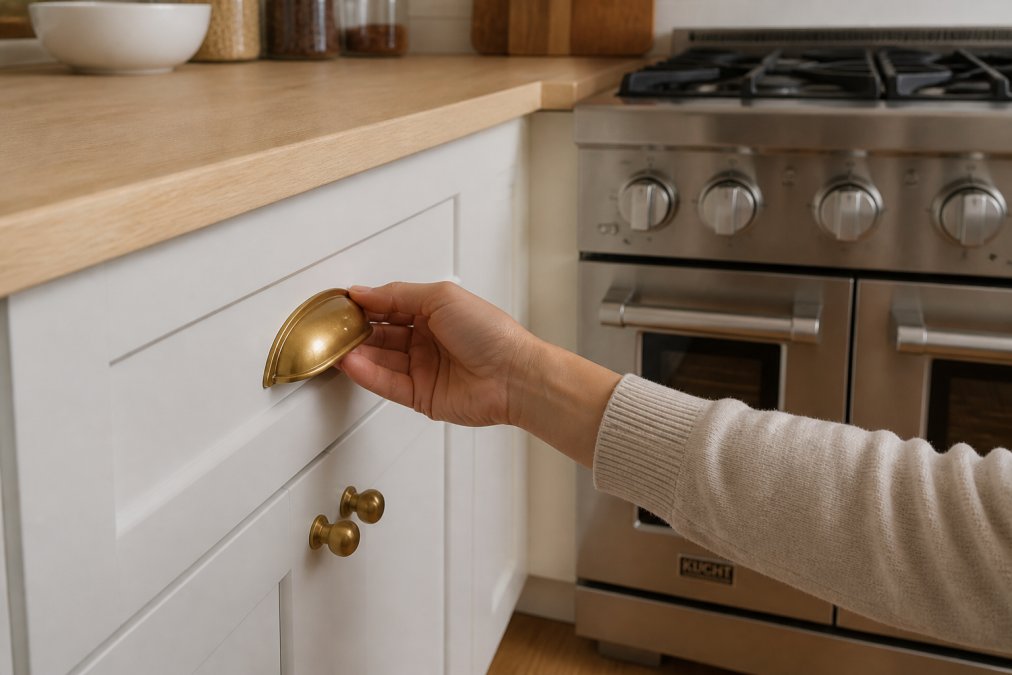
Solid, well-made hardware has noticeable weight relative to its size. A quality brass or stainless pull will feel substantial in your palm, not hollow or plasticky. Run your thumb along the surface. High-grade hardware feels smooth with finished edges, not sharp or rough.
2. Base Material Integrity
Solid brass offers the best combination of tensile strength, corrosion resistance, and durability. Stainless steel is another strong option. Zinc alloy sits in the middle tier: heavier than plastic, but softer than brass and more prone to cracking under stress. Avoid pot metal or unspecified "alloy" materials, which corrode quickly and don't hold screw threads reliably.

3. Finish Adhesion and Corrosion Resistance
A quality finish doesn't just look good on day one, it adheres uniformly and resists moisture, cleaning products, and daily contact. Poor finish adhesion shows up as bubbling, flaking, or uneven coverage. Quality electroplating creates a finish layer that bonds tightly to the base material. Check edges and recesses, where cheap finishes tend to thin out.
4. Screw Thread Integrity and Mounting Hardware
Budget hardware fails most often here. The screw holes on quality pulls and knobs are precisely threaded to accept standard machine screws without play. Loose threads strip easily and make reinstallation nearly impossible. Quality pieces ship with correctly gauged screws that match the hardware body precisely.
5. Backplate Fit and Projection Accuracy
The backplate should lie completely flat with no rocking or gaps. Even slight warping suggests poor casting or inadequate quality control. Projection, the distance the pull extends from the cabinet surface, should match specifications within tight tolerance.
6. Tactile Experience and Ergonomics
Good hardware is designed around how a hand actually grips it. Pulls should have a grip diameter that fits comfortably between fingers. Knobs should offer enough surface area to turn without slipping. The ADA Standards for Accessible Design provide useful benchmarks for hardware that's genuinely usable across a range of physical abilities.
7. Finish Consistency and Design Cohesion
Lay several pieces of hardware from the same order side by side. On quality hardware, the finish color, sheen, and texture match precisely. Design cohesion means proportions, profile depth, and overall aesthetic work across different cabinet sizes without looking mismatched.
Solid Brass vs Zinc Cabinet Hardware: Which One Lasts?
Solid brass outlasts zinc alloy in nearly every real-world kitchen condition.
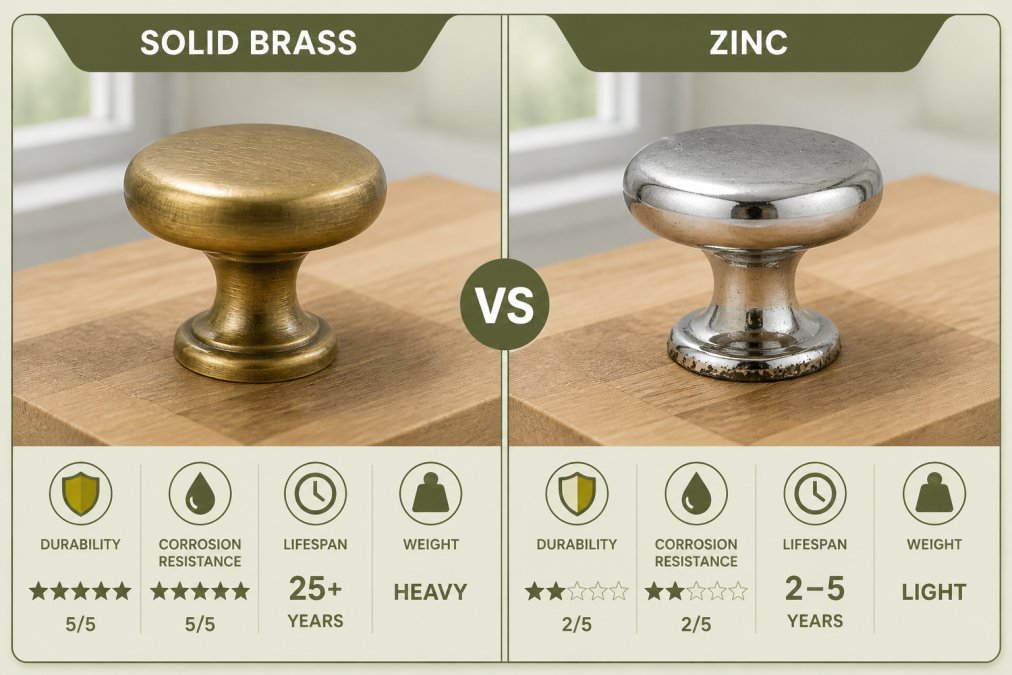
Solid brass is a copper-zinc alloy with high tensile strength and natural corrosion resistance. It doesn't rust and develops a patina over time that many homeowners prefer. Unlacquered brass shifts from bright gold to warmer, darker tones through normal oxidation, a living finish that's a feature, not a defect.
Zinc alloy, often sold as "zamak," is significantly softer. It machines well and costs less, which is why it dominates the budget market. The problem is that zinc alloy is prone to stress fractures under repeated load, particularly at screw holes. In high-humidity kitchens, zinc alloy with plated finish can show corrosion at finish edges within a few years.
| Feature | Solid Brass | Zinc Alloy |
|---|---|---|
| Tensile strength | High | Moderate |
| Corrosion resistance | Excellent | Fair (depends on plating) |
| Longevity | 20+ years typical | 5-10 years typical |
| Finish options | Broad, including living finishes | Broad, but surface-only |
| Weight | Heavier | Lighter |
| Best for | Long-term investment kitchens | Budget renovations |
If you're renovating a kitchen you plan to keep for more than five years, solid brass is worth the price difference. For short-term needs, zinc alloy with quality plated finish is reasonable.
Best Cabinet Hardware Finishes for Durability
Finish durability depends on the quality of the base material and the finish application itself. A perfect lacquer finish on weak base material will still fail. A thick, properly applied electroplated finish on solid brass will outlast the cabinets.
Satin Nickel and Matte Black
Satin nickel is one of the most durable finish options for kitchen hardware. The brushed texture hides fingerprints and minor scratches effectively, and quality satin nickel finishes resist chipping under normal use. It pairs well with stainless steel appliances and works across contemporary and transitional styles.
Matte black reads as sophisticated, hides smudges better than polished finishes, and works with many cabinet colors. Durability depends heavily on application method. Powder-coated matte black over solid brass is extremely durable. Painted matte black over zinc alloy is not. Check specifications for "powder coat" or "PVD coating," which indicate durable, bonded finishes.
Unlacquered Brass and Living Finishes
Unlacquered brass develops a natural patina as it oxidizes, shifting from bright gold toward warmer amber and brown tones. This patina is protective, not damaging. According to the Copper Development Association's material guidance, brass alloys naturally resist bacterial growth and surface corrosion, making them well-suited to kitchens.
Living finishes require a different maintenance mindset. You're managing how the patina develops, not keeping hardware looking new. If you prefer consistent appearance year after year, lacquered brass or satin nickel will serve better.
Ergonomics, Accessibility, and Hardware Failure Analysis
Hardware that's uncomfortable to use gets avoided, which means cabinet doors get pulled awkwardly and drawers get yanked open by fingernails. This damages both cabinet and hardware faster than normal use.
The ergonomic sweet spot for a drawer pull is at least 1.5 inches of grip clearance between the pull and cabinet face. This allows a full-finger grip without the hand pressing against the cabinet. Knobs require a pinch grip, which is harder for people with arthritis or reduced hand strength. For accessibility, bar pulls or cup pulls are generally easier than round knobs.
Most hardware failures happen at the mounting point, not the hardware body itself. Stripped screw holes, cracked backplates, and loose mounting screws account for the majority of replacements. This points directly to screw thread integrity and base material quality. Solid brass hardware with properly threaded mounting holes and correctly gauged screws rarely fails at the mounting point under normal residential use.
The second most common failure is finish delamination, where the finish separates from the base material. This happens fastest in kitchens with frequent steam exposure or aggressive cleaning. Choosing hardware with a PVD or powder-coat finish significantly reduces this risk.
Kitchen Hardware Maintenance Tips to Protect Your Investment
Quality kitchen hardware maintenance is straightforward but frequently done wrong. The most common mistake is using all-purpose cleaners that contain ammonia, bleach, or high-alkaline compounds, which strip finishes and accelerate corrosion.
Here's a practical maintenance approach:
- Weekly cleaning: Wipe hardware with a soft, damp cloth. For fingerprints and grease, use a small amount of dish soap diluted in water. Dry immediately.
- Monthly inspection: Check that all mounting screws are snug. Vibration gradually loosens screws and causes wobbling that accelerates wear.
- Finish-specific care for unlacquered brass: Apply a thin coat of natural wax or Renaissance Wax every six to twelve months if you want to slow patina development.
- Avoid: Abrasive pads, ammonia-based cleaners, bleach, and prolonged water contact.
- Polished finishes: Chrome and polished brass benefit from occasional non-abrasive metal polish to restore shine.
The National Kitchen and Bath Association's care and maintenance resources offer additional guidance on preserving kitchen finishes. Let moisture sit in recesses around backplates can cause cabinet finish to swell and hardware finish to corrode from the back side. Dry hardware thoroughly after cleaning.
How Quality Kitchen Hardware Connects to Your Whole Kitchen
Hardware is the one design element that bridges every surface in a kitchen. When hardware is chosen thoughtfully, it creates design cohesion that makes the whole kitchen feel considered.
The practical principle is finish coordination, not finish matching. You don't need every metal identical. What you need is intentional contrast or deliberate repetition. Matte black hardware against warm wood cabinets creates designed contrast. Satin nickel hardware paired with a stainless steel range and brushed nickel faucet creates cohesive repetition.
Hardware also affects the perceived quality of the cabinets themselves. Inexpensive cabinets with well-chosen, solid hardware read significantly better than expensive cabinets undermined by cheap pulls. This is one of the most cost-effective ways to elevate a kitchen renovation.
The Crestpoint Home collection includes the Kucht 48" Freestanding Professional Gas Range KFX4800X-S, a professional-grade range that pairs naturally with quality hardware. Paired with the Kucht 48" Wall Mount Range Hood KRH4821A in stainless steel, the result is a kitchen where every element communicates the same standard of quality.


Choosing quality kitchen hardware is one of the easier decisions in a renovation to get right, but only if you know what to evaluate. Weight, material, finish adhesion, thread integrity, and ergonomics are all things you can verify before purchase. Design cohesion is something you can plan deliberately. Crestpoint Home's curated selection of kitchen essentials is built around exactly these standards, with detailed product specifications, a dedicated support team available by phone, email, or live chat, and a commitment to products that perform as well as they look.
Frequently Asked Questions
How can you tell if cabinet pulls are solid brass or plated?
The most reliable test is weight. Solid brass drawer pulls feel noticeably heavier than zinc alloy or plated alternatives of the same size. You can also check the edges: solid brass is machined to a consistent finish with no thin spots, while plated hardware sometimes shows base metal at corners or screw holes. A magnet is another quick check, brass is not magnetic, so if the magnet sticks, the piece is steel or zinc with a brass electroplating over it.
What is the best material for long-lasting kitchen cabinet hardware?
Solid brass is the most durable base material for quality kitchen hardware. Its tensile strength resists bending under repeated use, and it does not corrode the way zinc alloy or iron-based metals do over time. For finishes, satin nickel and matte black PVD coatings offer strong corrosion resistance in high-humidity environments. Unlacquered brass develops a natural patina rather than flaking, which makes it a reliable long-term choice for homeowners who prefer a living finish.
What finish options are most resistant to kitchen wear and tear?
PVD-coated finishes, including matte black and satin nickel, rank among the most durable for kitchen environments. PVD (physical vapor deposition) bonds the finish at a molecular level, making it far more resistant to scratches, moisture, and cleaning chemicals than standard lacquer finish or electroplating. Unlacquered brass and oil-rubbed bronze are also strong performers, though they require periodic hardware maintenance to preserve their appearance. Avoid thin chrome plating on zinc alloy in kitchens, it chips under daily use.
Does the weight of cabinet hardware indicate better quality?
Weight is one of the most reliable indicators of quality kitchen hardware. Heavier pieces typically signal a solid brass or high-density zinc alloy base rather than hollow or thin-walled construction. A good drawer pull should feel substantial in the hand without being awkward to grip. That said, weight alone is not the whole story, the weight-to-size ratio matters. A large backplate that feels light likely has a thin base material, which affects both finish durability and screw thread integrity over time.
This article was written using GrandRanker